
NCPDP F6 · HIPAA RETAIL PHARMACY STANDARDS
NCPDP F6: what changes, when, and what it takes
NCPDP F6 replaces D.0 as the HIPAA-mandated standard for real-time retail pharmacy transactions. It touches claim billing, adjudication, eligibility, prior authorization and coordination of benefits, and it changes more than 300 data elements along the way.
THE DATE THAT DRIVES YOUR SCHEDULE
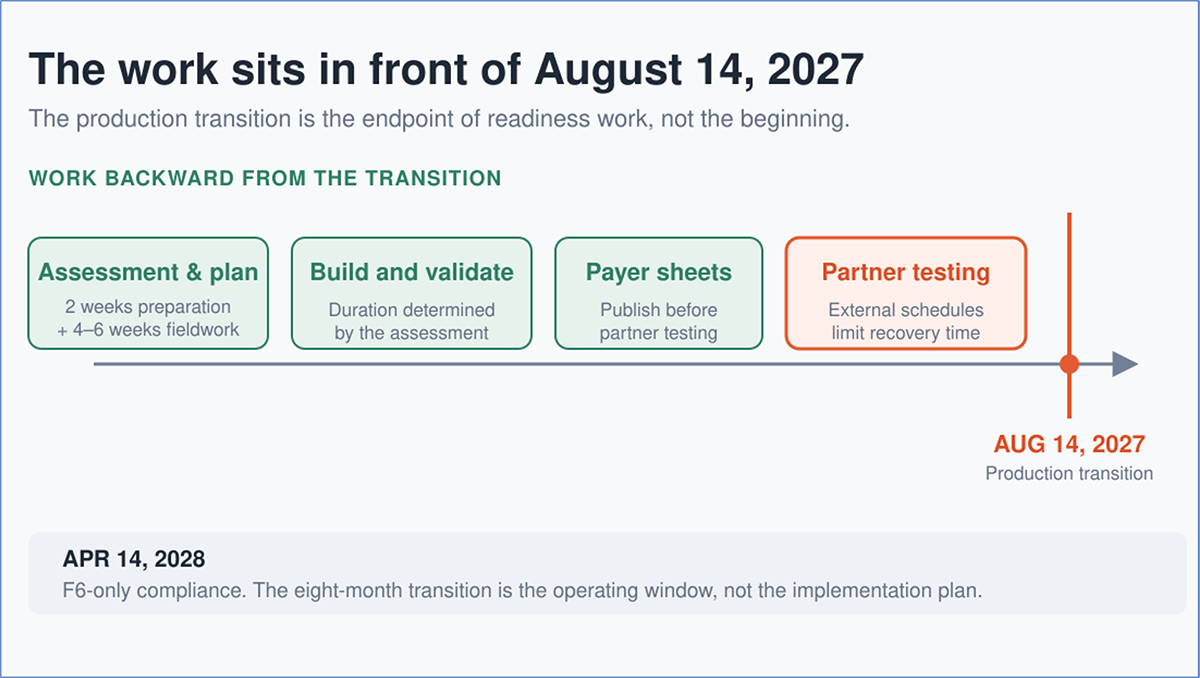
August 14, 2027
The transition window opens. Trading partners may begin exchanging F6 in production by agreement.
MANDATORY MILESTONE
April 14, 2028
Full compliance. F6 and Batch Version 15 required for covered retail pharmacy transactions.
What F6 is
F6 is not a payment standard
Who has to comply
On the provider side it reaches any entity that dispenses prescription drugs, whether retail, mail order, physician office, clinic, hospital or long-term care. Providers who do not dispense fall outside the retail pharmacy use cases HHS finalized.
Version 10 is state Medicaid only
Batch Standard Version 15 is the batch equivalent of F6. Same mandate, same dates.
Batch Standard Subrogation Version 10 replaces Medicaid Pharmacy Subrogation Version 3.0 for state Medicaid agencies only. HHS did not extend it to all health plans. Other trading partners may adopt it by agreement.
Data and AI governance, simplified
Benefit from our deep data and AI expertise and experience building business-tailored solutions.
APRIL 14, 2025
Effective date
The final rule took effect. Nothing was required of covered entities.
AUGUST 14, 2027
Transition window opens
APRIL 14, 2028
Full compliance
WORKING BACKWARD
Your start date
Why 2027 drives the schedule
You may have seen February 2028 quoted elsewhere
What actually changes
HHS documented more than 300 data element changes between D.0 and F6. Industry analysis puts the split at roughly 200 new fields, 150 modified and 50 removed. Treat that breakdown as analysis rather than a federal figure.
Five changes account for most of the implementation effort.
F6 does not land on one system. It lands on all of them together.
1. The header moves to an eight-digit IIN
D.0 uses a six-digit fixed IIN or BIN in the transaction header. F6 uses eight digits.
• The first change to the header section since Version 5.1 was adopted in 2002
• Header routing determines which processor receives a claim, so an error here sends the claim somewhere else entirely
• NCPDP recommends using only eight-digit IINs ending in "00" before full compliance unless the change is coordinated, because truncation during D.0 processing can misroute a claim
• The change reaches beyond the transaction into member ID cards, eligibility data, payer sheets and pharmacy network communications
2. Patient-pay fields consolidate
Thirteen distinct patient-pay fields in D.0 collapse into one qualified, repeating field.
• The structure is cleaner, but anything reading those fields has to be rewritten
• Affects accumulator logic, patient responsibility calculations, and downstream reporting that references patient-pay by field position
3. Coordination of benefits gains structure
F6 adds data elements identifying the previous payer and the payer program type, which D.0 handled through manual processes or inference.
• COB scenarios that required workarounds become explicit
• COB logic has to be rebuilt to populate and read the new elements
• During coexistence, other-payer ID fields have to accept both six and eight digit values
4. Financial fields expand for high-cost therapies
HHS cited therapies priced at or above one million dollars as part of the business case for F6.
• Under D.0, claims at that magnitude require split claims, free text, or paper Universal Claim Forms
• F6 expands the pricing fields so those claims submit normally
• Any system with hard-coded field widths or amount validations inherits work
5. Plan benefit information becomes structured
Benefit details that D.0 often carried as free text get discrete fields: effective dates, age limits, quantity limits, day supply limits, dollar amounts, remaining fills, formulary alternatives, duration of therapy and benefit tiers.
• Free text remains available for situations needing clarification
• Structured fields let pharmacy systems act on benefit information rather than display it for a human to interpret
The risk nobody is discussing: running both versions at once
How a claim reaches the wrong PBM
- Routing errors from IIN truncation. An eight-digit IIN truncated or mis-mapped during D.0 processing sends a live claim to the wrong PBM.
- Both ID lengths in the same fields. Systems processing D.0 and F6 concurrently have to handle six and eight digit values in other-payer ID fields. Anything assuming a fixed length fails on the values that do not match.
- Wrong patient responsibility amounts. HHS commenters warned that rushed implementation of the new pricing and COB fields could send incorrect coinsurance and out-of-pocket calculations to pharmacy providers, which surfaces as a patient at a counter being quoted the wrong price.
None of these produce a compliance finding. They produce claims that do not process and prescriptions that do not get filled, while every party involved meets the letter of the rule.
Which is why the strongest argument for starting early has nothing to do with the deadline.
What F6 means for you
Health plans and payers
• Reaches claims engines, payer sheets, eligibility feeds, accumulators, reporting, finance ledgers and member communications
• You gate your provider network through payer sheet publication
• You also depend on your PBM's F6 schedule, so internal readiness alone does not determine your date
PBMs and clearinghouses
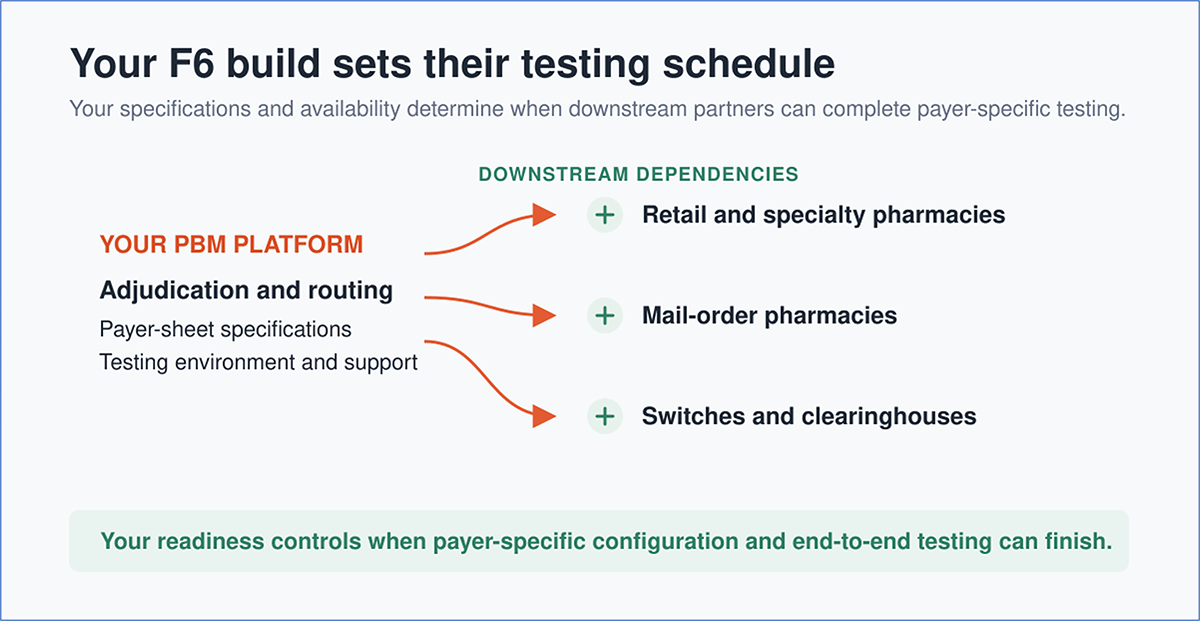
• You own adjudication, routing, reject-code logic, COB and DUR
• You publish the payer sheets and hold the certification capacity your trading partners depend on
• Every pharmacy and switch you serve certifies against your build before going live, which makes your schedule theirs
HHS estimated PBMs as the largest single implementation cost category at $128 million.
State Medicaid agencies
• F6 plus Subrogation Version 10
• Coordinated across managed care organizations, system vendors, claims and encounter reporting, rebates and program integrity
• NCPDP's 2026 letter to state Medicaid directors flags a 340B change from SCC value 20 to Submission Type Code D17-K8 with value AA under F6
Software vendors
• Schema, maps, parsers, validations and version routing
• Dual-version support through the entire transition window
• Certification with every switch you connect to, delivered while the current product keeps running for customers submitting claims today
• Your ship date has to precede every customer's testing, putting your working deadline ahead of theirs
HHS estimated pharmacy management system vendors at $95.2 million.
Pharmacies and dispensing providers
• Your pharmacy management system needs updating, and that timing belongs to your vendor
• Beyond the software: staff training, version coexistence through 2027, payer sheet interpretation, member ID card readiness
• Workflow changes for richer claim responses, DUR results, formulary alternatives and high-cost claims
How long this takes
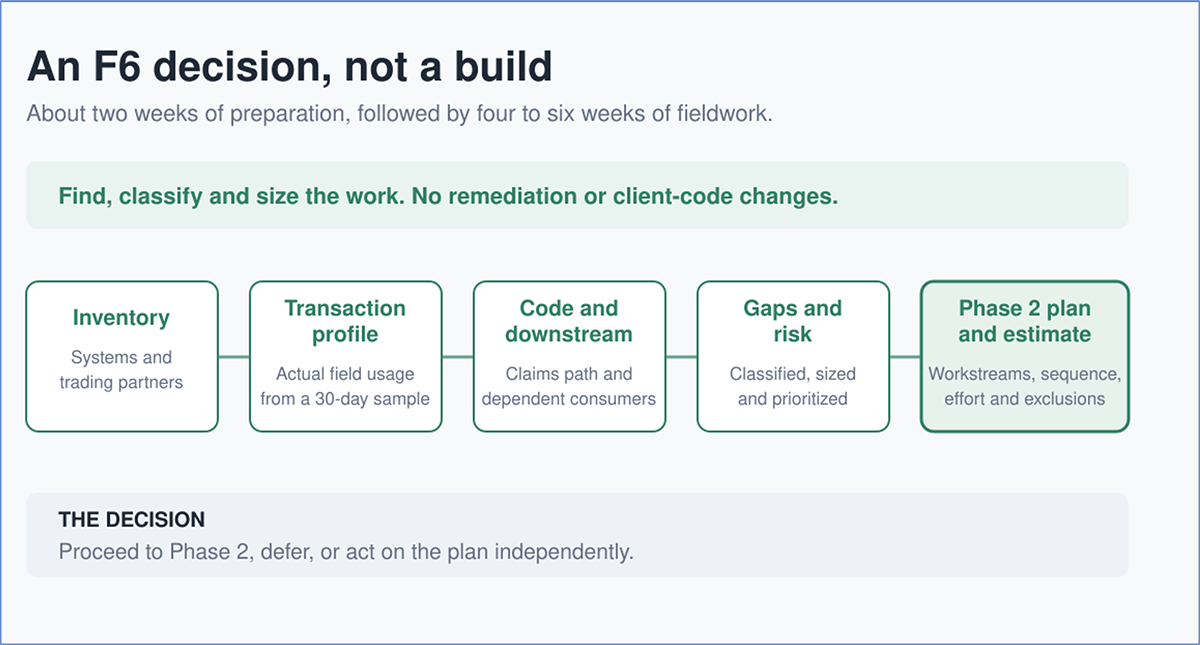
Planning closes before development opens
Testing resists compression
How OZ approaches F6
We start with a readiness assessment:
- an inventory of every system that touches an NCPDP transaction
- a gap analysis of D.0 against F6, field by field
- a review of what breaks while both versions run concurrently
- a map of who you have to test and certify with, and in what order
- a phased plan with effort and sequence
Then we help build it, alongside your team.
Go Deeper
The full F6 transition, in one document
Our white paper covers what changes, what it takes to get there, and where the upgrade creates value beyond compliance.

Sources
NCPDP Telecommunication Standard Version F6 Implementation Timeline and Activities